FAQ's

 Click here to go back to the roller main page

FAQ's (what website wouldn't be complete without FAQ's?)

How do you get started on rollers?  How are they made?   How do I choose between PVC or aluminum?   What difference does the drum diameter make?   Can I get a different color?   What's so important about precision machining?  and lastly.. we have to throw this out there..  The (in)significance of inertia, free-motion, and bumpers

How do you get started on rollers?

Click here for a great video from one of our friends who can talk you thru it.  And check out the roller manual to set up your rollers correctly


Details Of Roller Construction And Features

Spin balanced aluminum drums

All aluminum drums are spin balanced using modern computerized two-plane balancing equipment.  Spin balancing combined with the lowest industry tolerance for runout provides the smoothest ride on rollers that you’ll ever experience

Lifetime lubricated and sealed radial ball bearings.

Truly SEALED precision bearings give you no noise and lifetime performance.  A lot of roller bearings are only caged, even though they are claimed to be “sealed”.   Non-sealed bearings can become contaminated with moisture, dust and carpet fibers which will cause noise and premature failure. Our bearings are filled with high-temp grease and sealed with soft rubber seals on both sides of the bearing. We believe in over-design, so the load and speed ratings of these bearings are well beyond the most severe duty cycles.

Oversize axles (3/4” OD between bearings) will not flex.

At some time during the life of your rollers, you will probably come down hard on one of your drums during a fall, or in transporting your roller you may hit one of the drums.  A weaker axle will flex on impact and cause some runout by allowing a slight misalignment of the bearings.  So although it may seem that you damaged a drum,  in fact all you’ve done is bowed the axle slightly.  A oversize “beefy” axle will not flex so your drum should maintain its balance at all times.   Although the axles are hidden on assembled rollers, we encourage you to ask for specific dimensions from other manufacturers to assure you’re getting the value you’re paying for!

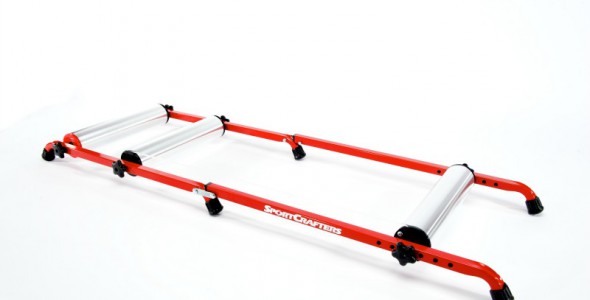
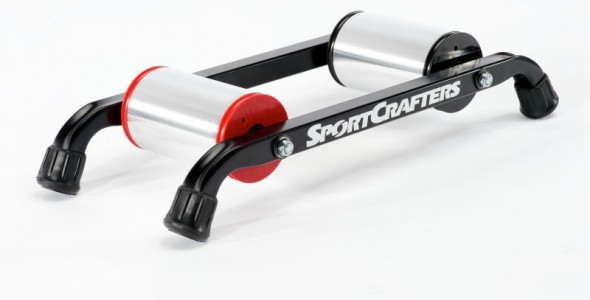
Rugged zinc plated AND power-coated steel folding frame always keeps 6 oversized rubber padded feet on the floor.

The frame uses very rugged 1” square, 16 gage tube from a local U.S. mill.   Note that most other frames use smaller tube size or flimsier extrusions.  The hinge in the middle of the frame allows enough compliance to allow all 6 feet to hit the floor so you don’t have to find the flattest floor to train on.  Once unfolded and ready to use,  you can put all your weight on the frame to step on/off without any flex or damage to the frame.   This rugged yet compliant frame design is critical to maintaining good balance and control.   We zinc plate and then powder coat for ultimate durability.  The US Navy uses powder-coat on seagoing ship components to protect them from highly corrosive and abusive environments.

The soft rubber feet are specially designed to absorb shock and vibration to help give you the smoothest ride.  Unfortunately the precision on the roller drums is no match for imperfections that are typical of bike tires and wheels, so we try to accommodate these imperfections as much as possible to give you the best ride with whatever equipment you’ve got.

Low profile keeps you close to the ground.

For getting on and off, as well as recovering from an occasional run off the side, you will appreciate being as low to the ground as possible.  The frame is entirely flat on the top to allow easier step on/off.  Note that other frames often put a stand-off hinge right where you’d like to step!  The drum axles extend through the frame rather than on top so that if you do ride off the side, your tire will safely contact a flat surface rather than an axle flange which can inflict more serious damage to your bike!

Knobs, not nuts. ... No tools needed for drum adjustment.

We know that a good roller may be used by several riders, often at the same workout session or event. Using knobs, we made it a lot easier to adjust the front drum.

Discussion On Drum Materials

Selection of material is important to a satisfying workout and lifelong use of your roller.


Aluminum PVC
Tires Does not wear tires (like some trainers) but can leave an aluminum residue on tires, so be careful indoors!
Note: Tires vary significantly in quality and cure of the rubber compound.  Some tires (regardless how expensive or cheap they are) can leave a black residue on the drums.  If this happens, the marks on the drums can be cleaned with a solvent, but we recommend switching tires.
Does not wear tires, and PVC material leaves no trace on tires.

Same comments apply to tires possibly leaving marks on the drum. If this happens, use only a mild solvent to remove residue from PVC drums.
Economy Best for long term, all-purpose use Best for indoor use
Noise Quiet A little quieter than aluminum (not much, though)  since PVC will naturally absorb audible sounds
UV/Heat resistance Not sensitive to normal environmental conditions in any area of the country.  We can not guarantee, however, lifetime performance in the crater of a live volcano nor at the bottom of the ocean. Keep away from sunlight and excessive heat or drum will warp and you may sense some vibration.  DO NOT transport in a car in the summer!

Discussion On Roller Drum Diameter

Selection of the proper drum diameter for your level of training is very important. Larger drum diameters of 4” or more are made popular by a lot of manufacturers, however you’ve probably noticed these are typically sold with resistance units. Large drums give you a relatively easy spin on high pressure road tires, and a little more aggressive spin on mountain bike tires.  If you train on hybrid or mountain bike tires and your body weight is above 170 pounds, you may want to stick with the larger drums.

Smaller diameter drums give you increased natural resistance from tire compression. Some rollers are as small as 2-1/4” which promise a very strenuous workout no matter who you are or what gear you’re in.  We don’t recommend this; rollers should always allow you a moderate workout to simulate a level road.  Whether you add resistance to provide some occasional uphill simulation is up to you, but you shouldn’t be fighting your roller constantly.

We’ve found that drums in the 3” to 3.5” range give you a good workout and relatively easy spin on high pressure road tires at your normal road speed range, assuming your body weight is less than 220 lbs and you’re in good physical conditioning.  Resistance can be added to these units if needed for stronger workouts, but most people find drum diameters in this range to give them the best overall training.    Resistance will change with speed, so your gearing will give you a very wide band of resistance range.

If your body weight is higher and you ride a road bike, the smaller diameter drums will give you appropriate resistance but you may need to gear down to a speed less than typical road speed.  Your other option is to step up in diameter if you want to use your normal gearing.

Color options

OK, so if red doesn't do it for you.. yes we can powder coat in just about any color you like.  It'll take a little longer and there may be an upcharge, but if lime green metalflake is really what you're after, give us a shout.  We also do a glow-in-the-dark powder coat, but let's face reality.. will you really ride your rollers in the dark?

The Importance Of Precision

All SportCrafters ZRO roller drums are lathe-turned on CNC equipment using a unique process of finishing the drum after it is assembled to the axle, using the axle as the center.   This takes into account all the tolerance contributions from the bearings, axles, bearing press into the caps, etc.   That’s how we can create such extraordinary tolerances on the finished drums, and why the competition can’t match it!

For the average cyclist, our “Rule-of-thumb” is that if you can see the run out on the drum (usually on the order of 0.005”), you will feel it.  If the run out of the drum is less than 0.005”, then generally the condition of your bike tire determines how smooth the ride will be.   For the more accomplished cyclist who will ride longer intervals at higher speeds, much tighter runout and balance are important to a satisfactory ride.   As always, the tighter the runout, the better the ride.  Also important is tight concentric tolerance control of the tubing and caps, which contributes to dynamic balance. Weight imbalance as well as tire and wheel condition can cause vibration under high speed.  We control all tolerances to assure proper balance.

Inertia, free motion, parabolic drums and bumpers .. Good or Bad?

Some products go to a lot of trouble to simulate what they call "realistic" conditions, and "security" features to make it easier to ride rollers, or to make you feel safer. While these may be marketable selling points, the fact is that training (in the most general sense) is NOT intended to bring a true riding experience indoors if your purpose for indoor training is to improve your cycling skills and efficiency.  Good roller training works on all of these areas;  technique, handling, cadence, coordination, balance and stamina.  

Inertia: First, there is no "realistic" inertia.  There's a huge difference in inertia going uphill vs flat road vs downhill.  Rolling efficiency (variations in tire pressure, tire type, rider weight, smooth road vs gravel or dirt, etc) also affect perceived inertia.  That said, the effect of inertia is to allow you to "coast" through the weak spots of your stroke without losing momentum on the wheel.  So where do you need the most training?  Where you are already strong or in the weak spots?  Training your weak areas of your stroke as well as your strong areas WILL improve your performance.  But obviously there's a limit to too little inertia or the stroke becomes choppy and uncomfortable, so we've optimized the rotational weight of the rollers to deliver a smooth spin and still allow you to work on the weak areas of your stroke.

Free Motion: There are several products on the market that are designed to allow the rollers to move fore-aft, which allows you to ride your bike "like you're outside", (aka; with reckless abandon out of the saddle).  They also claim to be easier and more forgiving.  These claims are true. But why would you spend MORE money for a training product that delivers a sub-optimal training experience?  Consider again WHY you're training on rollers.. it's not to simulate an outdoor ride so much as to help you become a better cyclist.  The eloquent thing about traditional rollers is that the relative instability (without free motion) provides you essential feedback on your handling skills so you are a more finely tuned power machine.  There's nothing you can do on free motion rollers that you can't do on traditional rollers, it just takes more time and skill development.  Personally, Pat trains about 90% on rollers (the ZRO110) and 10% on fixed trainers.  His FIRST race of 2013 was a 36 mile gravel road race in 28 degree weather after a snow melt, so there were large sections of smooth ice on the road, often well over a mile long.  Riding on ice felt exactly like riding rollers... it required keeping constant power, delicate handling and smooth stroke.  During the first icy section, Pat and another cyclist completely dropped the group of 100+ competitors, a scenario repeated many times over 36 miles.  Chatting after the race, Pat discovered that the other competitor who stayed with him trains exclusively on traditional rollers.

Small radius parabolic drums:  We've bought them and tried them.. they do nothing except give you a false sense of security.

Severe parabolic drums, large diameter drum caps and bumpers:  These are below your center of gravity, so if you're heading off the rollers they will do nothing exept cause you to fall over.  No different than walking and tripping over a tree root.  You're better off riding off the side, landing on the roller frame, catch yourself, and get back on.  We intentionally made our roller frame flat and wide and centered on the drum so that you can, relatively safely, ride off the side (Speaking personally again and borrowing a worn-out cliche "Been there... done that").  BUT even IF the bumpers did SOMETHING for you, once again they remove an element of training that is significant.  Being able to recover from your bike wandering to the edge of the roller drums on your own is essential to the new skills you'll learn on rollers.  You need the threat of falling off to push you to learn these skills... I compare it to bowling with bumpers in the gutter.  How you learn to adjust your body weight and steer the bike with precision and confidence will make you a better bike handler, whether you're a mountain biker or you prefer the road or triathlon.